

Appraisal Form Top Tips: Your Guide to Clear & Helpful Employee Reviews
Learn all about how to create and fill out a successful appraisal form in this helpful guide. We’re covering everything from…
Knowing how to take interview notes can improve your ability to find the best candidate. By building a strong interview note-taking practice, you’ll find it easier to remember details, build rapport, and gain insights into a candidate’s abilities. To help you, in this article, we’ll share what good interview notes look like with advice on the best ways to take them.

Interview notes are a written account of a job interview. The interviewer or someone assisting them may take them while the candidates present themselves. Candidates usually come prepared to answer interview questions, showcase their skills and experiences, or even give a presentation. To ensure interviewers make an objective decision and choose the best person for the job, all interview questions should apply to all candidates.
This makes compiling effective interview questions a vital component of the interview process. Without thorough and well-thought-out questions, interviewers may overlook candidates with relevant experience or they could miss out on a high-calibre job seeker.
When compiling interview notes, though, there are some typical elements to include:
Each organisation and team will have varying approaches and requirements when it comes to understanding how to take interview notes. Studies show how taking notes during or after an interview can help to organise your thoughts. And this, in turn, helps you make better judgements when it comes to candidate selection.
So let’s look at some other key signals of good interview notes.
It’s not necessary nor useful to capture every single word your interview candidates utter. This can happen when you don’t know how to take interview notes. Instead, it’s better to focus on being concise and capture only the most relevant points.
There’s nothing worse than going back to your notes to find you can’t read them or make out what you wrote at the time. Plus, messy handwriting or inaccurate note-taking will make it much harder for colleagues to make sense of them either.
Notes taken during an interview should focus on the job the candidate is applying for. So, rather than scribbling down each point, the points should match key requirements or competencies in the job description.
Keep your notes clear of any irrelevant information and avoid any personal references or irrelevant observations.

Learn more about our monthly newsletter for neurodiverse professionals
It’s fine to take notes during an interview but it’s important not to let your note-taking distract you from conducting the interview. Knowing how to take interview notes relies on effective questioning and listening skills. As you listen to the candidate, you’ll want to use good judgement in what to take note of or leave out.
By focusing on one aspect at a time, you’ll find it easier to capture accurate notes that can help you make the right decision when it comes to hiring.
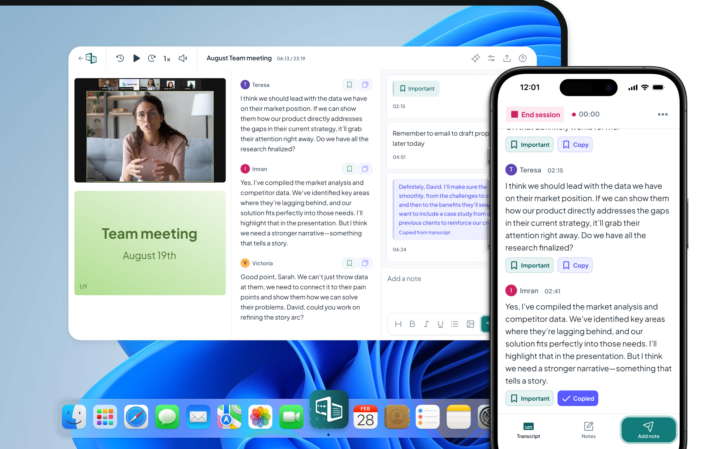
In the same way, you might take meeting notes, good interview notes should encourage active listening during the process and make you concentrate better on the interview. But it can also boost memory retention through the Generation Effect which makes it easier to recall pertinent information shared in the interview. If you’re worried about missing details, consider using a transcription tool to capture the conversation. For instance, running Caption.Ed during the interview can produce live captions and a transcript for you to refine into notes afterward.
Taking structured and well-organised notes provides a framework based on facts to test each candidate. In this way, frameworks reduce any influence from bias or subjectivity. This lack of bias helps to make decisions based on merit and experience and avoid any personal or unconscious bias. Intersectionality is a significant challenge in the modern workplace. And it’s an important one since half of all millennial and Gen Z employees say they’ll leave a company that doesn’t prioritise workplace inclusion.
According to CIPD, the Data Protection Act 2018 says job applicants can access all recorded information held on them. And that includes hard copies of interview notes and digital records. This makes retaining the official interview record with an accurate written note of why the candidate wasn’t suitable for the job very important. It’s also vital to destroy individual handwritten notes soon after and no later than 6 months.
Now you understand more about why it’s important to take notes, we’ll share our list of key points that should help you to understand how to take interview notes in your context.
Practice and preparation are essential components to ensuring you end up with useful and effective interview notes. So make the time in advance to practice your note-taking technique. Reviewing all candidate applications before conducting interviews can also give you an advantage when it comes to getting accurate notes.
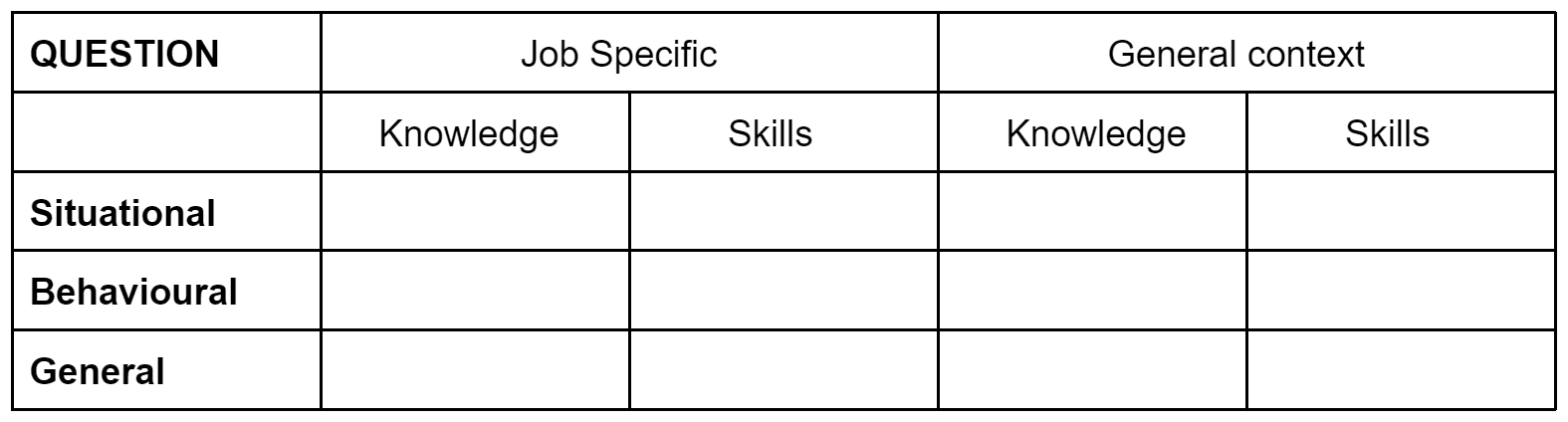
There are many ways to structure your interviews. However creating a matrix that structures your interview questions as Situational, Behavioural, and General may be beneficial. You may then find it easier to fit these into two further categories, one specific to the job and another in a more general or broad context. You can then break them down into two further subcategories: Knowledge and Skills.
So, your template may look something like this:
It may be tempting to jot down every point made by the interviewee but that won’t be useful to the process. Instead, focus on listening to what they’re saying and place note-taking below that priority.
By being an attentive listener to the content and details provided by the interviewee, you’ll make the job of getting precise and accurate notes much easier.
Don’t be afraid to highlight the important points your interviewee makes. Highlighter pens may be helpful or underlining points. Leaving an asterisk next to a key point to lead into further context may also be helpful.
You may also benefit from taking an active approach to note-taking. For instance, you could write out a separate explanation of the points raised by the candidate. Doing so could boost your comprehension and recall of the points made.
Soon after you’ve completed the interview you should focus on writing up the notes and clarifying all the points you heard. Doing this straight away is important since the information will be fresh in your mind. It will also help you recall key points and trigger the valuable information you need to make an accurate and judicious decision about which candidate is best for the position.

Our small but mighty team builds leading-edge software that people love. We pride ourselves on a user-led approach to product design. The voice of the customer shapes what we create and that’s exactly how great assistive tech should be made.
Learn all about how to create and fill out a successful appraisal form in this helpful guide. We’re covering everything from…

Performance reviews can feel daunting, but they should never be overlooked – reviewing performance can be extremely helpful for everyone involved.…

Ever feel as though your team aren’t quite achieving their true potential? That's where employee development plans come in. We’ve created…