



Dysgraphia in Adults: Signs, Challenges, and Support
Dysgraphia is a lesser-known handwriting difficulty that’s often mixed up with conditions like dyslexia and developmental coordination disorder (DCD). So, how…
ADHD meltdowns in adults are explosive outbursts of emotion like rage, shouting, and crying, along with some other signs. Caused mainly by a lack of emotional regulation, ADHD meltdowns can be difficult to handle. So, let’s look at what they are and how to manage them.

An ADHD meltdown is a sudden outburst of emotion such as anger and frustration that seemingly come out of nowhere. ADHD meltdowns in adults happen because adults struggle to regulate and process emotions. This can result in tantrum-like behaviour that some compare to a metaphorical volcanic eruption. Symptoms of an ADHD meltdown include:
People with co-occurring neurodivergence like Autistic Spectrum Disorder or AuDHD may also experience ADHD meltdowns, along with other associated symptoms from co-occurring neurodivergence.
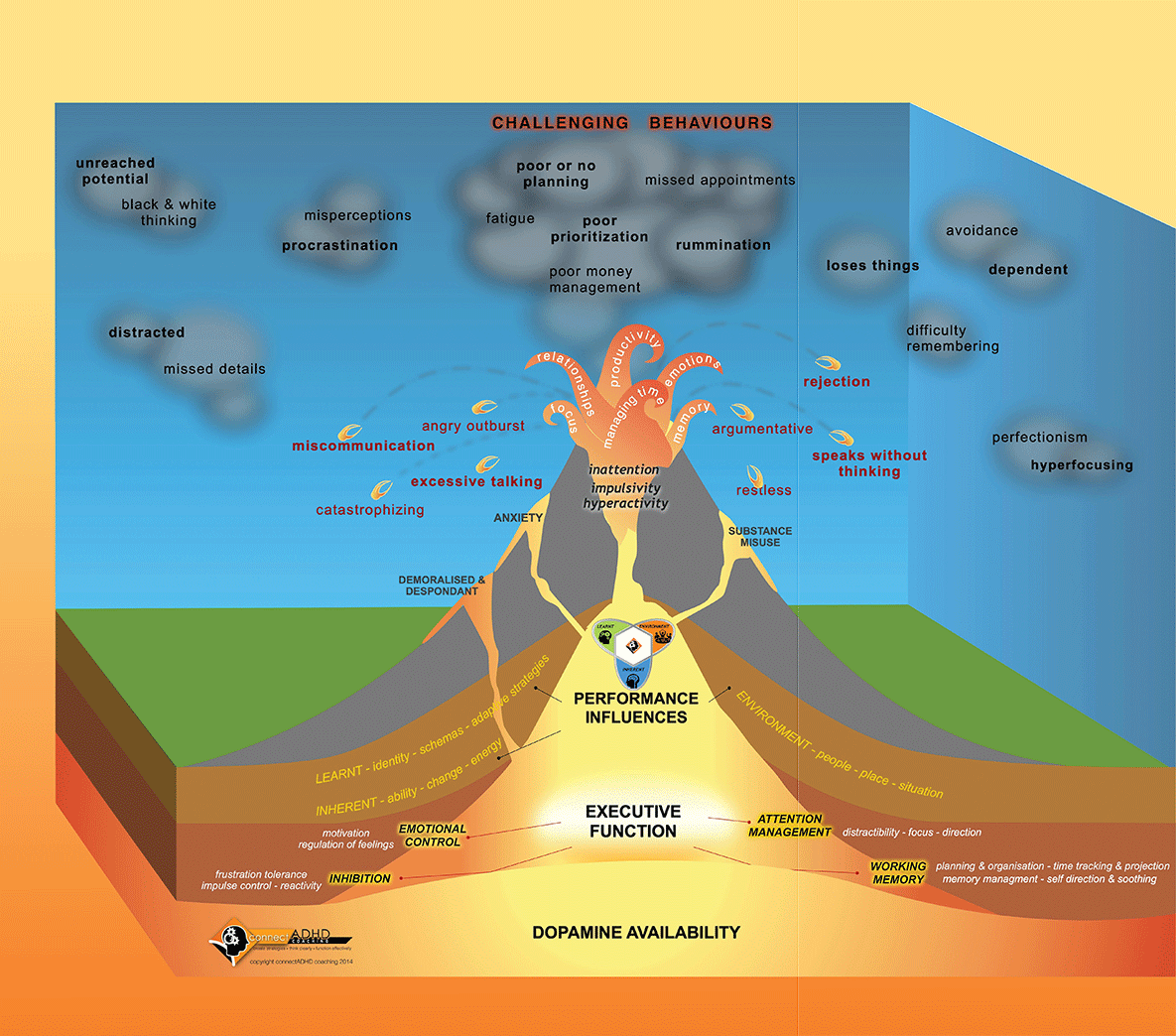
The US organisation CHADD (Children and Adults with Attention-Deficit/Hyperactivity Disorder) created their own ‘ADHD Volcano Model’ to illustrate the potential process behind ADHD meltdowns. Their model plots core symptoms, behaviours, influences, and executive function skills in people with ADHD and how these can create something similar to a ‘volcanic eruption’ when someone has an ADHD meltdown.
Their key point when it comes to meltdowns is that the eruption is the end result of a long process, not the beginning of one. By the time the eruption happens, the person has already exhausted their mental resources trying to manage the pressure underneath. Therefore, the solution isn’t to punish the “lava” (the behaviour), but to identify and support the “subsurface” struggles, like executive function gaps and environmental stress, before the pressure becomes too great to contain.
As illustrated in the ADHD volcano model and report, supporting executive functioning in people with ADHD may help to reduce the frequency or impact of ADHD meltdowns.
ADHD affects around 3-5% of the adult population and between 5-7% of children. According to DSM-5 mental health criteria, ADHD symptoms must appear before the age of 12 to get a diagnosis. But it’s also worth noting how ADHD has different manifestations throughout someone’s lifespan. And this makes it harder to receive an accurate diagnosis, especially if there are any comorbid conditions.
Symptoms of an ADHD meltdown will vary between adults and children. Initial signs that a child with ADHD may be about to have a meltdown include:
Symptoms of a meltdown may include yelling, crying, rage, and anger. And they’re different from tantrums since meltdowns are involuntary neurological reactions.
An adult ADHD meltdown may look like the following:
When an adult has an ADHD meltdown it can feel like a sudden burst of extreme emotion. Even minor triggers such as inappropriate words or small irritations can cause emotions to boil up within someone before they explode in inappropriate ways. Types of emotional responses can include anger, frustration, sadness, and fear.
Some people describe it as if they’re “physically exploding from the inside”. Others say they feel as though they’re overstimulated or overwhelmed. One example some people use is a metaphor of “having their emotional radio turned up to full blast”.
ADHD meltdowns happen when adults feel like they can’t handle difficult emotions. This can lead to a sense of feeling overwhelmed or out of control.
It’s not uncommon for people to question the difference between ADHD meltdowns, shutdowns, and tantrums. Here’s what you need to know:
An ADHD meltdown is a physiological response rather than a behavioural choice. Triggered by sensory or emotional overload, the brain’s executive functions become completely overwhelmed, and a person may lose the ability to process information or control their reactions, leading to an explosive release of built-up pressure.
An ADHD shutdown is similar to a meltdown in terms of what triggers it, but the response is more internal. Instead of an outward explosion, a person may become non-verbal, physically still, or emotionally numb. This is a vital survival mechanism for a brain that can no longer cope with its environment.
A tantrum is generally considered to be a goal-oriented emotional outburst that occurs when a person is struggling to handle a specific disappointment or a boundary they don’t like. While it can be loud and stressful for everyone involved, it’s often a sign that the person (often a child) is still learning how to navigate big feelings like frustration.
There are some signs to look out for that can help to prevent an adult ADHD meltdown. Breaking these triggers down into specific categories can help to avoid triggers and, if not, manage their impact as and when they occur:
We can attribute ADHD meltdowns in adults to several factors but specifically the following:
ADHD meltdowns can vary in length, depending on the individual and the situation. In general, meltdowns tend to last anywhere from a few minutes to around 30 minutes. However, the emotional aftermath may linger longer, as people with ADHD may feel drained or exhausted after a meltdown.
It’s important to remember that every person is different, and the duration of a meltdown can be influenced by factors like emotional regulation, external stressors, and coping mechanisms. Some people might bounce back relatively quickly, while others may need extra time to recover.
To help manage the duration and intensity of meltdowns, implementing strategies like mindfulness, taking breaks, and having a structured routine can be really effective in reducing both the frequency and the impact of these outbursts over time.
Prevention and management are both key when dealing with ADHD meltdowns. And there are many strategies to support both outcomes:
There are also steps that can be taken to reduce the frequency and intensity of ADHD meltdowns, such as maintaining routines and developing communication skills.
Mindfulness and a steady routine can help reduce the frequency and intensity of ADHD meltdowns by providing stability and lowering stress. Mindfulness techniques, like deep breathing, meditation, and staying present in the moment, can make it easier to manage emotions before they become overwhelming. Regular practice can improve self-awareness and create a sense of calm, making it less likely for emotions to spiral out of control.
Having a structured daily routine also brings a sense of predictability, which can be particularly helpful for people with ADHD. A consistent schedule reduces uncertainty and makes it easier to manage time and tasks. Simple habits, such as waking up and going to bed at the same time each day, using planners or visual schedules, and setting reminders, can make daily life feel more manageable and less stressful.
Good communication and social skills can make a big difference in reducing misunderstandings and frustration, which can sometimes lead to meltdowns. ADHD can make it tricky to stay focused in conversations, pick up on social cues, or express thoughts clearly, which might lead to confusion or conflict. Practising active listening, using simple and direct language, and being aware of emotions—both personal and in others—can help make social interactions smoother.
It can also be useful to work on self-advocacy and assertiveness, so needs and feelings are expressed in a way that others understand. Feeling heard and understood can lower frustration and make interactions less stressful. Social skills training, role-playing, or therapy (such as cognitive behavioural therapy) can provide practical strategies for improving communication and building stronger relationships.
Regular movement and good sleep habits can play a big role in managing ADHD and reducing the chances of meltdowns. Exercise, whether it’s playing a sport, going for a walk, or doing something fun like dancing, helps balance brain chemicals that affect mood, focus, and impulse control. It’s also a great way to release excess energy and ease stress, making it easier to stay calm and focused throughout the day.
Sleep is just as important, but ADHD can sometimes make it difficult to get enough rest. Poor sleep can lead to low energy, irritability, and trouble managing emotions, which can make meltdowns more likely. Sticking to a consistent bedtime, reducing screen time before sleep, and creating a relaxing evening routine can help improve sleep quality. Getting enough rest supports better focus, emotional balance, and overall well-being, making it easier to handle daily challenges.
An ADHD meltdown is an explosive outburst of emotion that occurs when someone with ADHD struggles to regulate and process their feelings. It’s a physiological response, not a behavioural choice and is triggered by sensory or emotional overload. Common signs include yelling, crying, physical reactions like stomping or throwing objects, and full-body tension.
ADHD meltdowns can be triggered by a range of factors. A person might be triggered by rejections or misunderstandings, sensory overload from loud noises, unexpected changes to routines, or stress, anxiety, and frustration from work or relationships. There are many possible causes.
Both meltdowns and shutdowns are triggered by sensory or emotional overload, but the responses differ. A meltdown is an outward, explosive release of emotion, whereas a shutdown is a more internal response where a person may become non-verbal, physically still, or emotionally numb.
No. A tantrum is generally deemed to be a goal-oriented emotional outburst (often seen in children) that occurs in response to a specific disappointment or boundary. An ADHD meltdown, by contrast, is an involuntary physiological response to neurological overload rather than a behavioural choice.
ADHD meltdowns can last anywhere from a few minutes to around 30 minutes, though this varies depending on the individual and the situation. The emotional aftermath may linger longer, as people with ADHD can feel drained or exhausted once the meltdown passes.

Our small but mighty team builds leading-edge software that people love. We pride ourselves on a user-led approach to product design. The voice of the customer shapes what we create and that’s exactly how great assistive tech should be made.
Dysgraphia is a lesser-known handwriting difficulty that’s often mixed up with conditions like dyslexia and developmental coordination disorder (DCD). So, how…

Many people with autism report finding it easier to focus on one task at a time, known as “monotropism”. While monotropism…

There’s a lot of confusion when it comes to understanding ADHD in men. In this helpful guide, we explore different types…