

Using Active Recall to Study More Effectively
Feel foggy-headed when revising for exams? Active recall, a process which involves actively testing knowledge throughout the revision process, can be…
Note-taking is a key life skill. But it’s rarely taught and mostly acquired. So why is note-taking important? Well, for many reasons that we’ll outline in this post.

Note-taking is a long-standing method for recording information in writing. Note-taking allows us to create a written record of what’s been said during a meeting, lecture, or event. This makes it easier for us to recall what happened afterwards.
When people record notes, they may do so informally, recording basic words or ideas that are jotted down in a notebook, or more formally, creating polished summaries to be shared with others. In the context of a meeting, the latter is often referred to as meeting minutes.
And while it may take time to develop fluid skills in note-taking, there is no reason to delay picking up these skills. Students, especially, should understand why note-taking is important as early as possible. And that’s because it can support and enhance your learning during lectures and seminars.
So, to help you pick up the right note-taking skills during your studies, here are some reasons why note-taking is important.
If you’ve explored our guide to different note-taking methods, you’ll see there are lots of note-taking options to suit different styles of learning. Here’s a quick recap of some of the key methods:
The Sentence Method: The Sentence Method is all about jotting down short, numbered lines as ideas come. It’s perfect for fast lectures because you can capture information quickly without worrying about structure.
The Cornell Method: The Cornell Method centres around splitting your notes into three columns. You create a thin column for headings or questions, a larger column for more detailed notes, and a wide box at the bottom for your summary points. This makes it easier to make sense of your notes and can be used for studying and self-reflection.
The Outlining Method: Outlining is where you create a bullet‑point system, ordered by importance. It’s great for organising ideas clearly and making revision fast. It helps to keep notes clean and structured so you don’t have to skim through loads of irrelevant information.
The Mapping Method: Mapping is a visual way of spreading ideas out from a central point on the page. It’s great for spotting links between concepts and makes complex topics easier to digest at a glance.
Scribing down every word of a presentation is not only hard to do but it’s also inefficient. And in practice, it’s not the words that are most important but the meaning behind them.
In fact, students’ writing speed averages around 0.4. words per second. So in reality, there’s little hope of anyone keeping up with lecturers’ speaking rate of 2 to 3 words per second.
In practice, rather than stumble along trying to keep up, it’s better to develop techniques and strategies to help you capture the salient points. And with these techniques, you’ll eliminate any fluff or bluster and end up with what matters.
Most of us can relate to the experience of ending a conversation and forgetting what the other person said. And with so many distractions around us or thoughts in our minds, who can blame us?
But note-taking can focus your attention much better on the content of a discussion, presentation or lecture. Plus, it helps you absorb the information better.
Take the instance of a test sample of mock jurors, who had their note-taking abilities examined during a mock trial. Results indicated that those who engaged in note-taking had higher rates of recall than those who didn’t.
Another helpful reason to answer the question ‘why is note-taking important’ is its ability to help you learn.
Want to Know More About Our Products?
One way it can do this is through a process called the Generation Effect. And this is the concept of suggesting that, if you generate something from your own mind rather than simply read it off a page, you’ll be more likely to remember it.
In practice, using the Generation Effect during note-taking requires you to find synonyms, codes or words you can make your own. In essence, this allows you to adapt the material to suit your own style or preferences. And this act works to boost your memory.
The Generation Effect is actually a form of encoding, which is the first stage in your brain’s process of memorisation. And it precedes two other stages – storage and retrieval.
So, try using the Generation Effect to aid your memory during the encoding stage.
Another advantage of note-taking is that it can help stimulate your cognitive functioning, helping you to spot connections between disparate points.
In essence, this is what lies at the heart of creativity and helps enhance your ability to generate new ideas or see new patterns.
One method you can apply to achieve this is Luhmann’s Zettelkasten or the ‘Slipbox’ method.
This is the act of using index cards to capture key points. And by capturing a summary of the points in one box, you’ll find it easier to join these unconnected concepts together to create new ideas.

Learn more about our monthly newsletter for neurodiverse professionals
Reflecting on what you’ve learnt will help to solidify your learning and enhance your memory storage. And the best way to reflect on what you’ve learnt is to refer back to notes taken during a session.
A study by Ozbay, 2005, found that note-taking is in fact a specific process that requires active cognitive processing. And it takes the form of several steps starting with listening, followed by comprehending then analysis and selection.
They also found that note-taking while listening provides a higher level of cognitive processing that engages other processes such as evaluation, interpretation and decision-making.
And reflecting on this is much easier when you’ve taken a killer set of notes.
One reason note‑taking can be so beneficial is that it helps to manage cognitive load. When too much information sits in working memory at once, your performance drops because your brain is busy remembering instead of thinking. According to research, writing things down reduces that pressure, freeing up mental space so your attention can stay on problem‑solving rather than juggling details. This can be particularly useful if you’re neurodivergent and find yourself overwhelmed by thoughts or struggling to stay organised.
Findings from psychology researchers Mueller and Oppenheimer also show that writing notes by hand, instead of using a laptop, encourages people to summarise and process information more actively. Because you can’t write as fast as someone speaks, your brain is forced to prioritise meaning over word-for-word transcription. This extra layer of mental processing helps to cement concepts more firmly in long‑term memory.
Developed by psychologist Hermann Ebbinghaus, the “Forgetting Curve” demonstrates how quickly we lose information when we don’t revisit it. After learning something new, our memory declines sharply within hours, then continues to weaken over days. According to Ebbinghaus, reviewing notes at spaced intervals dramatically slows this decline. This means note-taking can be used to interrupt the forgetting curve and strengthen long‑term retention. Curious to test it out for yourself? You can learn more about it in our blog: Using Active Recall to Study More Effectively.
There’s no single “best way” to take effective notes, but these simple tips can help you improve your approach and find something that works for you:
Explore active note-taking for important subjects or ideas. Active note-taking is when you actively engage in the task of note-taking with the intention to learn as you write. Rather than just copying something verbatim or writing everything you hear, you put things into your own words. This allows you to really absorb what you’re writing and understand the information better.
Review notes you’ve made before and highlight what you find helpful. Note-taking isn’t just a way to “look busy” in lectures and meetings. It’s there to help you learn and remember information. Going back through your past notes helps you to spot areas that were useful versus the bits where you were just scribbling frantically and nothing seems to make sense. Seeing this contrast allows you to refine your future note‑taking, so you can put your notes to good use.
Use note-taking methods that suit your learning style. If you’re a visual learner, you might be better off taking notes with visual charts or maps. If you prefer to actively listen, you could use dictation software or a note-taking tool that records notes for you. Don’t force yourself to adopt methods that feel clunky or unnatural. If you follow what feels right for you, you’ll get much more value out of the practice.
So, in answering the question ‘why is note-taking important’ we hope you’ll see that it’s not just important but essential to your learning to take notes. Particularly for any stage of learning, whether that’s in higher education, further education or work.
Taking notes during meetings, seminars or lectures engages a higher level of cognitive function. It uses a specific process that improves your memory storage, recall and in turn your ability to learn and store information.
By finding the right method, technique or style that suits your learning needs, you’ll realise the benefits of note-taking in any context and want to apply them every time.
Assistive technology can be used to support and enhance communication for people at workplaces and universities. CareScribe is at the forefront of assistive technology and our products address a wide range of needs.
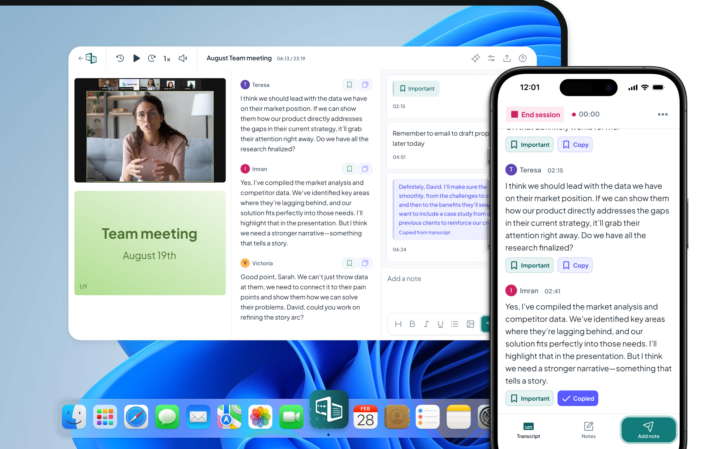
Featuring a set of custom dictionaries with live captioning and note-taking functions, Caption.Ed can add captions instantly to your meetings, lectures or seminars, either in-person or online. You can also add timestamped notes, synced to your transcript, and highlight key information so you never miss out on the important stuff.
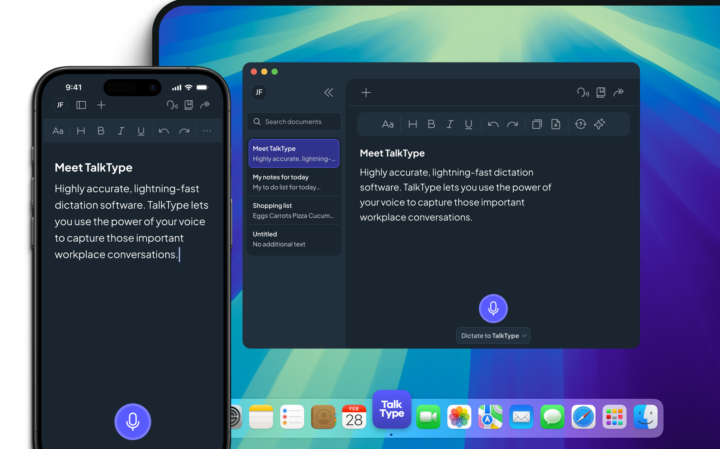
TalkType is highly accurate dictation software built for Windows, Mac, and mobile devices. Dictation software like TalkType can transform the way you work and study. As well as boosting productivity and efficiency, dictation software can provide autonomy to anyone who cannot type using traditional keyboards.
Caption.Ed and TalkType are dynamic AT tools that are transforming outcomes across many workplaces and universities.

Our small but mighty team builds leading-edge software that people love. We pride ourselves on a user-led approach to product design. The voice of the customer shapes what we create and that’s exactly how great assistive tech should be made.
Feel foggy-headed when revising for exams? Active recall, a process which involves actively testing knowledge throughout the revision process, can be…

YouTube has become an invaluable platform for sharing information, entertainment, and sharing educational content. Whether you’re a content creator, researcher or…

You may be new to Microsoft Teams or a veteran user. Whatever your experience, you should know how to record a…